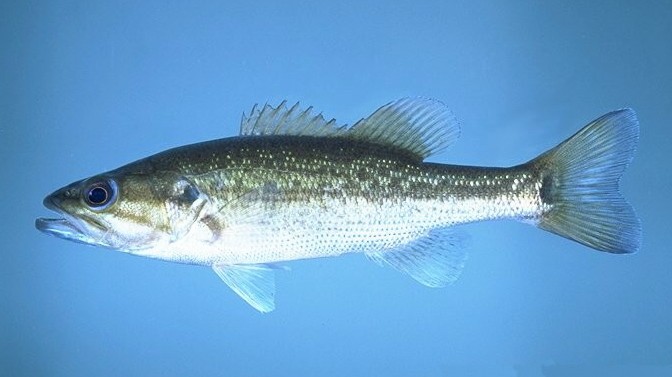
How to recognise it
- The side stripe is more broken than a largemouth bass's.
- With the mouth closed, the jaw ends at the back edge of the eye, not past it as on a largemouth bass.
- Rows of dark spots on the whitish belly look like thin stripes.
- Has a tooth patch on the tongue; most largemouth bass don't.
Habitat: where it lives
- Likes more current than largemouth bass, and tolerates warmer, murkier, slower water than smallmouth bass.
- Native to East Texas from the Guadalupe River to the Red River, but not the Edwards Plateau.
Habits: behavior, spawning and growth
- Diet changes with size: zooplankton when young, then insects, then fish and crayfish.
- Spawns over rock or gravel at 57–74°F. Females lay 1,150 to 47,000 eggs, and the male guards them, and the young for up to four weeks after they hatch.
- Much smaller than a largemouth: the largest known in Texas is just over 5.5 lb. Still an excellent fighter for its size.
Where and when
- Likes more current than largemouth. Native to East Texas rivers such as the Sabine, Neches and Cypress.
- Spawns over rock or gravel when the water is 57–74°F.
- In reservoirs: main-lake points, creek mouths and the lower lake near the dam, 5–15 ft deep, often suspended off the bottom in clearer water.
Bait and lures
Lures
- 4–6 in straight-tail worms (green pumpkin or watermelon) on a shaky head or drop shot
- 5 in stick-style worms
Why these baits work
- Adults eat fish and crayfish, which is why small soft plastics in natural colors (green pumpkin, watermelon) dragged along the bottom work.
Rod and reel setups
Grouped by lure fishing (artificial baits) and bait fishing (live or natural bait).
Tips
- Drag a shaky head slowly across deep points, 10–40 ft down.
- They school: once you catch one, stay put and keep casting there.
Size and bag limits vary by state, species and lake. Current limits: Texas (TPWD); elsewhere, your state's fish and wildlife agency. Check before you keep a fish.